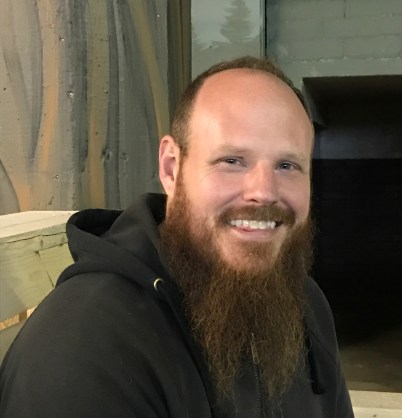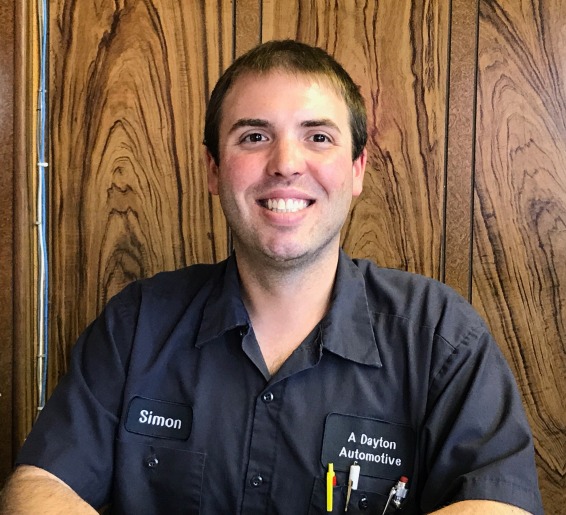
Simon Ward: Owner & Technician, A-Dayton Automotive

W Simon useHow do philosophy and ice hockey lead to a career as an automotive services shop owner and technician? Simon Ward has blended skills learned in both areas with his lifelong interest in auto racing. I asked Simon how he crafted his career. The highlights of his story follow.

In the beginning…

use W Simon w Lyn St James 1985
Simon with Lyn St. James, Indy racecar driver, 1985

Growing up in Oakwood, Ohio, Simon Ward’s father exposed him to auto racing at an early age. “My dad took me to the race track for the first time when I was two weeks old…a Formula One race in Detroit”.

His grandfather liked to fix things, including cars, and often Simon helped.

use W Simon w Dad racecar
Simon with his Dad’s racecar

Later his father got into amateur racing with Sports Car Club of America (SCCA). “I was right there learning the pits, torqueing tires, learning how to make adjustments, change tire pressures, stuff like that”.

Cars weren’t Simon’s only interest. He played in the band and spent a lot of time traveling with his club ice hockey team.

How did philosophy enter Simon’s life?

use W Boulder Colo
Boulder, Colorado

After graduating from high school, Simon enrolled at the University of Colorado as an open major. “I actually didn’t know what I wanted to be”. After taking some courses, philosophy and psychology made sense to him. “At 18 years old, philosophy was a great thing to think about”.

As a result of his years playing ice hockey, Simon got a job at an ice rink, driving and maintaining the Zamboni. He also became a referee and managed the referees. “Long days, high energy, taking it as it comes, being a referee, managing all those people…I learned a lot like that”.

use-w-zamboni-e1497017803801.jpg
Zamboni

 After graduation, Simon got a desk job. He lasted three months. “Driving to work watching the sun rise, driving home watching the sun set, sitting in a cubicle all day long, just wasn’t for me”.

 Did Simon stay in Colorado?
Since Simon hated his job, he decided to return to Dayton. Using his contacts in Dayton, he found a job with a landscaping company, driving and maintaining the mowers. “That’s where I started learning how to turn wrenches”.

Simon also enrolled at Sinclair College, Dayton, Ohio, in the Automotive Technology program. “My motivation was that I wanted to go racing”. Sinclair gave him the opportunity to begin building his racecar.

Simon wasn’t sure where he wanted to go, but he kept earning his automotive certifications until “I realized, wait a minute, this might be a little more of a financial opportunity than landscaping, might have a better chance of a career path”.

use w auto repair
Brake disc repair

With that in mind, Simon left landscaping and got a job at Preferred Fleet Services (PFS), a subcontractor maintaining trucks for the US Post Office. “That’s where I turned into a mechanic”.

What did Simon do when he finished at Sinclair?
“I got my master’s certification with National Institute for Automotive Service Excellence (ASE) (ASE Certified Master Technician)…I had the top score in the country, so I won the Technician of the Future Award … a big stepping stone”.

Although he’d learned a lot at PFS, the work felt like the “same truck over and over again – because it’s the Post Office”. Simon switched to John Pierce Auto Care, Fairborn, Ohio, as the lead technician diagnosing drivability issues. The job expanded his experience exponentially. “I had the fundamentals and this gave me the opportunity – all makes, all models…they gave me the hard stuff, the stuff that no one else could figure out, the stuff that no one else wanted to figure out…is it an engine issue, transmission issue, brake issue, electrical, is it mechanical, and make a diagnosis and go from there… I started realizing maybe I could do this a little deeper”.

Drivability diagnosis made Simon appreciate his background in philosophy, particularly logic systems. “These are logical beasts that we deal with: if A, then B. You have to follow logical paths to diagnose these things and I’ve found that training is invaluable in this industry”.

Simon also finished building his racecar and started racing with SCCA, mostly at Mid-Ohio Sports Car Course and Nelson Ledges Road Course.

KONICA MINOLTA DIGITAL CAMERA
Simon racing his Mustang at Mid-Ohio

“It costs a lot to go racing. There’s two ways to do it: either you pay someone to do it or you do it yourself. I didn’t have the money to pay someone, so I learned how to do it myself…My racecar was not the most expensive investment. You have to get there, stay there, have all the tools there, service the car there, have all the spare parts, have all the infrastructure to support anyone who comes with you, so there’s a lot of investment that goes into that…it’s an educational opportunity to see how much it takes to get from this idea to actually driving down the track”.

In addition Simon began doing side work in his garage. “That’s when the business idea started really getting flowing”.

How did Simon move from working for someone else to opening his own shop?
Through SCCA Simon met the owner of a shop that supported multiple amateur drivers. After several conversations, the owner asked Simon to take over the company. It was an attractive idea. Simon began to review the opportunity, hiring a lawyer and accountant for the due diligence.

Simon continued to work at John Pierce Auto Care and do side jobs on cars in his garage. One day he contacted the owner of A-Dayton Transmission about a transmission issue. use W sign2That contact lead to more conversations. As Simon was reviewing the racecar shop opportunity, he began to think, “What if this doesn’t work out, what if I did something else?” Consequently, Simon directed his due diligence team to analyze a possible purchase of A-Dayton, too.
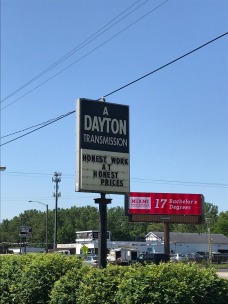
Both the owner of the racecar business and the owner of A-Dayton called Simon on the same day and said, “Let’s do this, make this happen”. Simon chose the racecar opportunity.

He spent the next nine months traveling with the owner to racetracks “to work on cars and deal with really experienced drivers… that have the expendable income to race these fun cars”. Every weekend the two of them would go to a racetrack to support three drivers who were “paying between $8,000-$10,000 a weekend to show up and have that car ready to go”.

After nine months, Simon recognized that the racecar business wasn’t what he wanted. He’d had professional conversations with the owner of A-Dayton during that period, but nothing more. Shortly after the racecar opportunity faded, the owner of A-Dayton “contacted me back and said I’m interested, I’ve dropped my price”. Simon thought, “Now he’s serious”.

In order to structure the deal, Simon relied on his lawyer, accountant and others with broader business background. “I understood the business side of it to a certain extent, I understood cars very well. Find money – it was time for me to reach other people who knew a lot more about that than I did”. In 2014 Simon finalized his purchase of A-Dayton Automotive & Transmission Services.use-w-front-door.jpg
Has Simon’s experience with A-Dayton Automotive met his expectations?
In Simon’s original business plan, he expected:

  • He would run the office while he worked on cars
  • The services did not include transmission work

Those expectations quickly changed. He learned it was tough to run the office and work on cars at the same time. “I originally thought I was going to be out here, answer the phones, go back to work on cars. No… I was the only person here for the first two weeks…and I didn’t get anything done. The phone would ring, I would answer it, run back into the shop, turn a few wrenches, run back, answer the phone, order some parts”. Now he helps his technicians diagnose drivability issues and relies on their expertise to do the work.
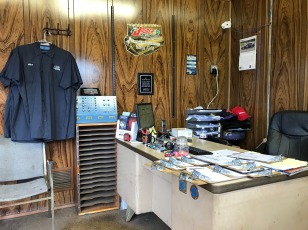
use W office
A-Dayton Automotive office

Although A-Dayton had dealt solely with “American made automatic transmissions”, Simon’s business plan was “from day one we were a full service shop” with no transmission work.

Three weeks after the purchase, the prior A-Dayton owner asked to return. “He wanted to make sure that I learned the customers, learned the business”. Simon hired him on a part-time basis to work on transmissions for the first year. The prior owner’s presence “brought all the fleet service he had coming to him, all the contacts that he had out there, the other shops that would recommend work to him – that brought that all back into play and really helped build the business for that first initial year”.

In addition to teaching Simon the business, Simon also learned about transmissions – “how to build them, how they fail, how to diagnose them and I also learned that a lot of people don’t like them, including a lot of other shops, so we get a lot of work from other shops…Transmissions paid the bills for the first year”.
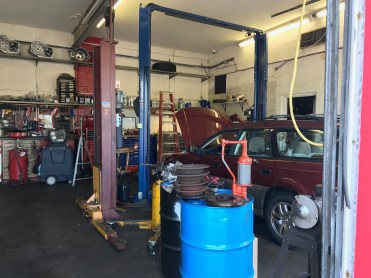
use W car in bay
A-Dayton Automotive bay

The prior owner bowed out after a year. Now Simon is running the business with two technicians and himself. Although it hasn’t always been smooth, Simon has learned from his mistakes and transitioned from being a technician to being a business owner.

Simon’s observations:

  • This business has similarities to refereeing ice hockey games. You have to “see what’s going on, keep your eyes open, see everything that’s happening”
  • “It’s a lot of work, it’s a lot of stress, it’s a lot of responsibility. These guys got to get paid, they have families and everything else that has to ride on this stuff, too, the investors have to get paid, you have to pay the debt and you have to pay everything else and at the end maybe I’d like to make a little money, too”
  • Since a lot of trial and error goes into the first three years, a good support structure of family and friends is very important
  • “It’s not the industry it used to be”. Automotive technicians have to have computer literacy, logic skills, and problem solving ability. “You’re not just the greasy dirty guy under the car…I spend a lot more time at the computer instead of under the car”
  • Dealing with customers has exceeded his expectations. “I’ve always been hiding under the hood or driving the Zamboni…I really enjoy being up here and actually interacting with all the people…it’s probably been the most enjoyable aspect of it for me”
  • “I like the challenge…I like the hard stuff, give me a car that people can’t figure out. When we solve the problem, it’s a mutual happiness in the shop”.
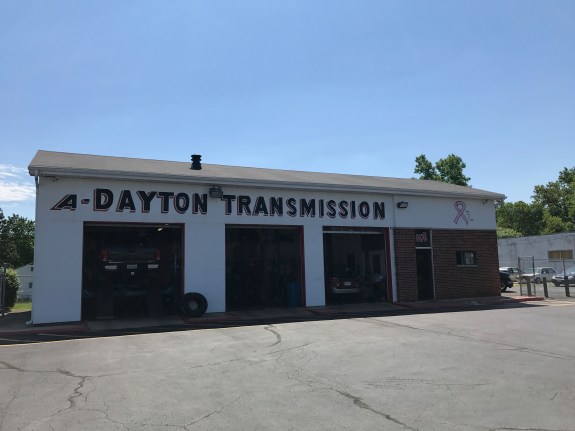
use W shop3
A-Dayton Automotive
1676 Woodman Drive
Dayton, Ohio 45432
(937) 253-9934
adaytonauto@gmail.com
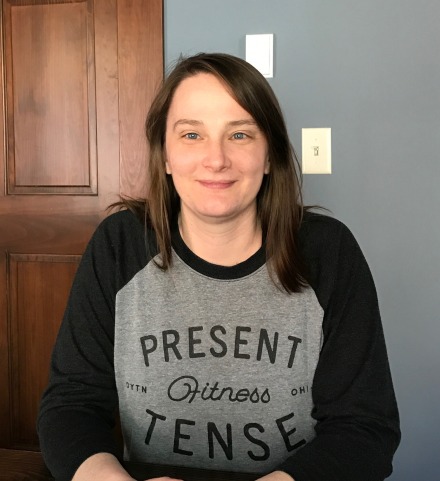
Susan Harrison: Software Engineer and Nutrition Coach

PT Susan croppedWhat if you’re really good at your job and it should be your dream job, but it doesn’t capture your interest. If you’re not sure what would excite you, how do you decide your next steps? Susan Harrison is wrestling with those questions. I asked Susan how she is crafting her career. The highlights of her story follow.


In the beginning…

As valedictorian of her graduating class at Wayne High School in Huber Heights, Ohio, Susan Harrison said, “I was good at school”, but she wasn’t sure what should be next.

UD sign
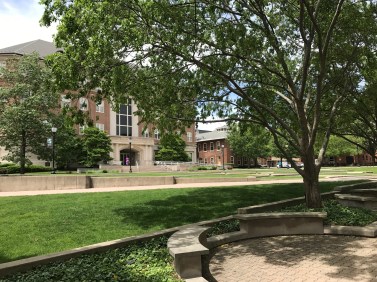
Entrance to the University of Dayton

Susan enrolled at the University of Dayton with a hazy idea of her future. The options she knew were doctor, lawyer or teacher. Since she liked science and math, she began as a pre-med major. That didn’t last long. “Chemistry sucks and premed is almost all chemistry”.

UD bldgs U
University of Dayton campus

Susan’s high school boyfriend, Jason Harrison, asked, “What classes that you took did you like? What did you enjoy doing?” She told him that she liked physics and math. Since his brother was studying electrical engineering, Jason suggested it. Susan reviewed the curriculum and thought, “Oh, this looks perfect”.

“Electrical engineering had a lot of problem solving to it, where you took these basic circuit classes where they laid out a circuit and you figured out what it needed to work or how the current ran. It was just the way it worked was interesting in terms of a problem solving thing for me”.

Using her contacts, Susan found co-op internships at GM and Heapy Engineering. Her “dad worked with signal processing at Wright Patterson Air Force Base and knew guys who spun off to start company, so I got a job with them”.

ee solder
Electrical engineering soldering equipment

The company built signal processing hardware for the federal government to decode signals intercepted from satellites. “I actually learned how to design and build hardware. I spent a ton of time actually soldering parts on boards …I actually kind of miss that part of it”.

What did Susan do after graduating from college?

Susan and Jason had maintained their relationship through college and eventually married. After Jason graduated from The Ohio State University, he planned to move to Washington, D.C. to work for the CIA.

United States Capitol building in Washton, DC
United States Capitol Building, Washington, DC

Susan’s Dayton employer used their contacts in the DC area to help her find a job with TMA, providing technology services to the United States government.

At first Susan designed signal processing hardware, but within six months, the company trained her to write software code.

Within two years, Susan was bored. That “felt wrong because I had a top-secret security clearance, I was getting to travel…I just had access to really interesting things and the work should have been really interesting”. Although elements of the job were interesting, “the process of what I had to do day-to-day never really grabbed me…I still can’t articulate why…I was so young I didn’t know what to do with that…so I kind of tried to make myself like it”.

Although she was unhappy, Susan couldn’t see her options. “Everyone I met was doing some version of what I was doing, so it still didn’t broaden my knowledge about what was out there”. Nonetheless, she stayed with TMA for five years.

What did Susan do next?

By then Susan’s stepfather, Jack, was nearing the end of his battle with cancer. Since neither Susan nor Jason liked their jobs, they decided to quit and move back to Ohio to be with family.

By chance, Susan’s mother, Diane, met Tim Nealon. Nealon was working with Dayton Public Schools and the University of Dayton to design the Dayton Early College Academy (DECA) to prepare first-generation urban students to go to college. Diane introduced first Jason and then Susan to Nealon. DECA hired them as founding teachers, and they moved to Dayton.

How did Susan make the transition from being a software engineer to a teacher?

Susan had considered switching from software engineering to social work, so she liked the idea of helping urban students. DECA smoothed the transition by:

  • Paying the tuition for the Masters in Education program at the University of Dayton
  • Scheduling Susan and Jason to help with the program during its first year
  • Moving them to teaching after they had their Masters

During the first three weeks of school, however, one of the math teachers left and DECA tapped Susan to take over his classes. She got her emergency teaching certification and negotiated a reduced load in the Masters program.

DECA2 U
Dayton Early College Academy High School

Before school started, Susan and Jason visited all their students at home to meet their families and begin to involve them in the school. Throughout the school year, they worked “late into the evenings…doing stuff on weekends, doing stuff with the kids outside of school”.

Teaching at DECA was the “hardest two years of my life…I’m an introvert…I had some strengths in the relationship building with the kids, but I wasn’t a good teacher…and my personality type was working against me”. After two years, Susan and Jason left.

When Susan realized teaching wasn’t right for her, what did she do?

Susan and Jason were in Dayton for Jack’s last year and the hard year afterwards. Then they said, “We’re 30, we’re free in terms of what we want to do, let’s just do it”. They moved to New York City so Jason could to pursue screenwriting and acting.

NYC U
New York City

Susan assumed she’d easily find another software engineering job, but discovered that her prior jobs had been specific to the intelligence world, which didn’t exist in New York. Additionally, without an Ivy League background, she couldn’t get past the application. Eventually, she found a job at an online Wall Street trading company on the support desk.

That was the only job Susan ever held that was solely for the paycheck. She realized she valued positions that supported either people or the interests of the United States. After four months, she left Wall Street for a technology job with the New York City Department of Education, managing the Salesforce online database.

In Susan’s first year, twenty experimental schools used the Salesforce database to track attendance, report cards, and discipline records. Susan built it out and traveled to schools to train, pull data, and troubleshoot. The job was fascinating, but she chaffed under her boss.

After two and a half years, Susan left the school system and contracted independently with Exponent Partners, which worked with the New York City schools and nonprofit organizations as a partner of the Salesforce Foundation.

Did Susan stay with Exponent Partners?

LA view U
Los Angeles

As a consultant to Exponent Partners, Susan worked from home, making her position portable. After four years in New York City, she stayed with Exponent Partners when she and Jason moved to Los Angeles and then back to Washington, DC.

When they returned to Washington, DC, Susan did leave Exponent Partners for two years, because she was frustrated. The company was growing very quickly, and everything seemed disorganized. When her mentor from her first DC job offered her a job with his new company, working with the FBI, she accepted.

FBI bldg DC
FBI Headquarters, Washington, DC

Susan was doing software engineering work in the FBI headquarters. One of her most interesting projects was designing a software threat prioritization system for cities. At first the work intrigued Susan, but again she grew bored quickly. After two years, she called Exponent Partners and returned to her prior job as an independent contractor.

Exponent Partners appears to have been a steady factor in Susan’s life. Was anything else bubbling up?  

While they lived in LA, Susan started an online business with her sisters. Building on her interest in genealogy, they created Style My Tree to design modern-looking family trees. Susan discovered that, although she loved working for herself, working with family was challenging.

During their time in New York and LA, Jason had worked as a personal trainer. In DC Susan and Jason started Present Tense Fitness as an online platform for Jason to offer wellness, nutrition, and lifestyle coaching anywhere.

After four years in DC, Susan and Jason made a fast decision to move back to Dayton to assist with Jason’s parents. They asked themselves, “Are we the people who come home and help or are we the people who just ignore it and have to come home for stuff that’s awful?”

How did Susan’s life change in Dayton?

Susan was able to continue with Exponent Partners without missing a beat. As Jason considered his options, Susan said, “Do what you know”. Since he had experience working as a personal trainer, he adapted Present Tense Fitness to engage clients for 1:1 training.

Jason rented space in two different gyms to train clients, but quickly found he was spending too much time traveling between sessions. Susan and Jason understood the advice, “Don’t open your own space until you have to”, but that time had arrived. They opened Present Tense Fitness in downtown Dayton’s Oregon District.

How has involvement in Present Tense Fitness influenced Susan’s direction? PT 1

For years Susan has “been searching for what it is I wanted to do, and all I could come up with is that I want to do something that is my own and not somebody else’s”.

Currently, Susan continues to work for Exponent Partners and also uses her skill at “taking technical stuff and making it understandable to people” as a Precision Nutrition coach. She and Jason are developing their vision for the Present Tense Daily Brief, a daily wellness guide Jason writes and emails to subscribers, by asking, “What’s your ideal day? What do you want to be doing when you’re 50 all day?” They are using their answers to “try to see what that long-term picture looks like and then work back from there. What do we have to do today to make sure we get there”?

Susan’s Observations:

  • “Do what you already know and what you like to do; don’t chase what’s currently in vogue”
  • “Your business doesn’t have to appeal to everybody”
  • “Get the people who are your champions”
  • “Don’t be afraid to make people mad. I’d rather have people have a strong feeling about us, because … there’s also the people who are going to have an equally strong like of us and those are the people who end up building your business”.
PT bldg use
Present Tense Fitness
222 E. 6th Street, Dayton, OH 45402
(202) 603-0926


Cathy Dean: Founder/Owner iheart cleaning

Cathy2Perhaps you’ve worked in a management position for several years. You’re good at it, you work hard, and you’re a valued employee. Then one day you wake up and say, “This cannot be my life”. What do you do next? Cathy Dean has been there. I asked her how she crafted her career. The highlights of her story follow.

In the beginning…

Cathy Dean has always enjoyed working with people as part of a team. At Wayne High School in Huber Heights, Ohio, “I was in the band. I wouldn’t say that I was good at it, but I enjoyed the social aspects of being in the band”.

During high school, she assumed she might be a teacher, but when she enrolled at Wright State University, she decided she wanted to work in Human Resources (HR). “I love the interactions with people”.

Cathy planned to enter Wright State’s College of Business to focus on HR after finishing her general education requirements, but the College of Business had a GPA requirement. She shocked herself by falling short. “I also had a boyfriend. During that time of my life I don’t think I was as focused on school as I should’ve been”.

How did Cathy regroup?

Cathy took a semester off and then transferred to Sinclair Community College to study Business Management. While at Sinclair, she also worked almost full-time as a teller at Citizen’s Federal Bank. “I’ve always been super focused on working. I like to be busy, I can’t really have a lot of idle time”.

She grew to like working at the bank, recognized the connection to business and management, and thought she might make it her career path. “Those years were a time when I was all over the place, but I was still really determined to finish, couldn’t just walk away and not finish school”. She got her Associate’s degree and intended to continue working at Citizens Federal, but Fifth Third Bank acquired Citizens Federal and there were too many changes.

What did Cathy do? Did she stay?

Cathy moved on to National City Mortgage Company as a customer service representative. Although she loves people, “being on the phone wasn’t necessarily my dream job”. Nevertheless, she stayed in that job for a year and a half, because “It was good for me. I was so young and in this big world of business people”.

After she had her foot in the door at National City Mortgage, she transitioned to the real estate tax department and hit her stride. She became a “team lead” and then a manager.

What did she like about working at National City Mortgage?

Early in her career as a manager, senior management decided would be more profitable to do the bulk of the real estate tax processing internally rather than sending it out to vendors. Cathy joined a team of managers tasked with building the new system. “It was a huge project that was fun and challenging. We were creating a team of people within our department – finding the right people to fit the positions”. She discovered she enjoyed the project. “It was fun seeing something grow from such a little seedling to this huge unit of 100 people”.

NCM managers

Meeting to problem solve

Each manager was responsible for a different piece of the system, and they worked closely to coordinate functions and troubleshoot problems. “Because it was such a new team and everything was moving so quickly, the managers were in it together. It was fun to work together towards something and see it come to fruition”.

In the process, Cathy gained the “bulk of my true management experience”. She was able to exercise a lot of flexibility and autonomy to make decisions for her unit. Her personal challenge was learning the soft skills of being a manager and leader. She learned how to handle disciplinary circumstances, understand different work styles, and guide her staff.

During this time, Cathy also had a small business on the side, selling candles at festivals. Although the business didn’t last, she acquired an accountant and some experience as an entrepreneur.

It sounds like Cathy enjoyed the work at National City Mortgage. Did she stay?

Over the years, the team of managers fit the pieces of the new real estate tax processing system together until it worked like a well-oiled machine. Then the real estate bubble crashed in 2008. To lower coasts, National City Mortgage explored outsourcing the process, eventually sending the bulk of the work to India. “That was like a punch to the gut, because our amazing team that we created started to dwindle and people were let go – a big life lesson for me”.

Cathy spent three weeks in India training their replacements. When she returned, work didn’t feel the same and Cathy began to consider other options.

Cathy decided being a realtor “would be fun and interesting to help people purchase homes”. After getting her license on the weekends, she left National City Mortgage. That was a scary move, because she had been there for 11 years, “my whole young adult life”.

She became a realtor at the height of the Great Recession and lasted for three months. She had to make cold calls to recruit potential clients, and quickly realized, “I am not good at this and I don’t have any money”.

Her next job was in an Allstate insurance office. A coworker inspired Cathy to go back to school. “I’d built this great career for myself at the mortgage company, but I only had an Associate’s degree which wasn’t going to help me get some of the jobs I wanted.” Today you “have to have a bachelor’s degree like you have to have a high school diploma”.

Cathy took out student loans and enrolled at Indiana Wesleyan online to pursue HR management. Working full-time at the insurance agency and going to school was hard. “I don’t even remember those points of my life”.

After earning her bachelor’s degree in two years, Cathy started looking for a job in HR, but immediately ran into roadblocks. Employers thought she had too much management experience for an entry-level job, but, since she lacked HR experience, they didn’t think she fit their HR jobs.

Assurant Springfield OH
Assurant Springfield, OH

Needing to earn money,  Cathy found a job at Assurant Specialty Property in Springfield, Ohio, working with the mortgage, tax, and insurance industries for four years.

Cathy worked for over 20 years in the financial services sector. Why did she leave to start a cleaning business?

In 2015, Cathy turned 40 and said, “This cannot be my life”. She was “tired of being under the finger of someone else with very minimal control”.

bucket
Time to start cleaning!

Fed up with corporate constraints, Cathy told her husband, “I’m just going to clean”. She thought she could “make decent money at a good physical job, build my own hours and be my own boss.”

What steps did Cathy take to start iheart cleaning?

Cathy thought she would clean on her own, until she met her good friend, Mandy, for coffee to talk and get some advice. Unexpectedly, Mandy offered to help. Cathy thought, “Cool, that seemed better!”

Cathy loved having Mandy to discuss the business with, because figuring out “how to even clean seemed way more complicated than I actually realized.” Their first steps included:

  • Building pricing – at first they underpriced everything
  • Developing a systematic approach to attack jobs
  • Obtaining general liability insurance
  • Becoming bonded
  • Figuring out marketing

In the beginning, Cathy and Mandy had no clue how to price a job or attack it, so they learned by trial and error. Their first customer told them she was a “bit of a hoarder and hadn’t cleaned in a while”. They gave her an estimate based on the time they thought the job would take, but quickly discovered they had seriously underestimated. It took three of them two and a half days to clean the kitchen, one bedroom and a bathroom. “Now we know not to give an estimate on the time a job will take”.

BNI2Soon after launching her business, Cathy accepted her accountant’s invitation to join a chapter of BNIBNI is a worldwide business-networking group of individuals from many different professions, which meets weekly, to discuss business strategies and challenges, and share advice.

When she was just working from home, Cathy didn’t know how to get the word out. Once she announced the launch of iheart cleaning to her BNI group, however, the floodgates opened and business skyrocketed. “Everybody’s a friend of a friend of a friend.”

Cathy is glad Mandy has been with her from the start. “Our strengths really balance each other. You have to be educated. I have Corian countertops, but there’s granite and marble and all of these different stones and all of these different types of care”.  Mandy taught her about the different types of surfaces, so they can clean without causing damage.

stove b4 and after
Before and after

Other resources Cathy’s used:

  • “We have a flooring person in our BNI group and he has really educated me. Now I can look at a floor and say, ‘oh, that’s marble’”
  • Blogs and podcasts about cleaning techniques and business practices
  • Facebook group focused on cleaning; “I can see mistakes that people make across the country and I know I’m not alone”
Toilet b4 and after
Before and After

Cathy’s dream is “to have people in place so we can focus on things that we need to do to grow the business”. She believes a social media presence is important and would love to write a blog on cleaning and organizing.

Currently Cathy and Mandy “spend 24/7 wading through all of the logistics of having a business, doing the work and hiring people”. Although the business is much bigger than Cathy’s original idea, needing six of them to do the cleaning, she says, “It’s fun to watch it grow”.

Cathy’s observations:

  • Join a networking group so you can meet people who can be your sales force
  • Do your research
  • Find what works best for you; sometimes your don’t know until you make a mistake
  • Be transparent with your customers; tell them immediately about any issue before they bring it to your attention
  • Be resourceful in finding good employees; that’s the most challenging part of the business.

iheart2

Mike Bisig: Founder/owner of Mike’s Bike Park, musician and educator

MikeWhat if the activities you love don’t seem to fit into a coherent career path? Mike Bisig loves jumping his bike over hills and speeding around curves. But he loves music even more. He has adapted his career path, weaving music and cycling into his life. I asked Mike how he crafted his career. The highlights of his story follow.

In the beginning…

Since his childhood in Wilmington, Ohio, music has been Mike Bisig’s passion; both playing music and helping others learn how to play. His instrument of choice is the saxophone, although he’s an expert in most woodwinds, and also plays guitar. He reached such a high level of proficiency on the saxophone in high school that he was able to earn money by giving lessons.

His other passion emerged later. As a kid, Mike rode his BMX bikeKids on BMX everywhere with his friends, but didn’t become serious about cycling until after college. He had no idea it would lead to Mike’s Bike Park. He laughed when he said his “high school counselor would not have picked this as a career path”.

At Wright State University, Mike embraced his passion for teaching music by majoring in music education and used his love of performing to forge long-term friendships.

Mike graduated from WSU with a degree in music education. What was next?

Mike wasn’t sure what he wanted to do, so he taught private lessons to approximately 40 students and worked at Absolute Music in Fairborn. There he quickly realized that he enjoyed sales.

Mike believes that “life is a series of connections you make with people”. At Absolute Music, he got to know the regular customers, including the band director for Greenon Local School District. That acquaintance led to a part-time job with the Greenon high school band and then a full-time position teaching music.

While working with the Greenon band, he continued to teach private lessons, as well as completed a Master’s degree in music education.

After several years, Mike reached a decision point: whether to settle down at Greenon or explore his options. He decided to leave the teaching field entirely and move to join a college friend in Honolulu for a year.

Greenon, Ohio to Hawaii is a huge leap! What did Mike do there?

Mike is a big believer in planning, so he started saving his money a year before he walked away from the Greenon job.

Waikiki
Waikik Beach Honolulu, Hawaii

Mike rapidly discovered he didn’t want a car, because parking in Honolulu is “insane”. His friends biked everywhere, so Mike did, too. At first traveling by bike was terrible, because “Hawaii is uphill all the time”. He was young, however, so it didn’t take long before he adapted.

Since some of the most beautiful areas in Hawaii aren’t accessible by car, so Mike quickly got hooked on mountain biking. He discovered:

  • Cycling enthusiasts are super nice regardless of skill level
  • Biking’s physical demands are fun
  • Spectacular scenery is just a ride away

Honolulu is an expensive place, however, so Mike quickly ran through his money. The local bike shop, Island Triathlon & Bike, needed a salesman, so Mike got a job.

Island Triathlon & Bike used professional cyclists as salesmen; Mike was their first casual rider. The pros, focused on performance, related best to other pros, whereas Mike reached out to everyone. In the process, he discovered he was good at selling bikes and equipment to the casual rider. Mike stayed, became the manager of the shop, and learned more about sales in the process.

Mike was having a great time in Hawaii. Did he stay longer than a year?

Mike stayed true to his plan and left Hawaii at the end of that year. Back in Ohio, he traveled for a year between Dayton, Columbus and Cincinnati, working with secondary school bands. He hated all that driving.

But once again, Mike’s connections paid off. A friend in Hawaii called to ask him to come back to Hawaii to run it a new high-end bike shop, Momentum Multisport.

Diamondhead 1
Diamond Head, Oahu Island, Hawii

Mike returned to Hawaii. Since Mike was involved in all the promotional activities, he got a hands-on education in PR basics. But he didn’t have to learn how to how to make promotions lively. From his years of playing music, he knew that innately.

Mike continued to love mountain biking,

Triathlon
Triathlete in training

but he also got interested in road biking. Momentum Sports provided training and support for triathlon cyclists. As the shop’s representative, Mike trained groups of triathletes, and led group rides. His “love of the bike grew and grew”.

Hawaii was wonderful, but family issues tugged at Mike. He was traveling back to Ohio every six or seven weeks, and, after a year, he decided to move back to Ohio.

When he returned to Ohio, did Mike chose teaching again or stay with bike sales?

Mike returned to his old job at Absolute Music, but this time he traveled to various school districts to serve their music needs. In that capacity, he reconnected with an old friend in the Beavercreek City School system. Since Mike had his Masters degree and was up-to-date with his licensure, he could easily to return to education. Beavercreek had a huge band program with a ready-made studio for teaching lessons, and Mike started teaching lessons.

After a year, he gained a teaching position in the band program, which led to his current position as the Assistant Director of Bands.

Mike said working with a high school band is a special type of teaching. Managing a band is like “running Fortune 500 Company on a teacher’s pay and with not a lot of resources”. The job requires skills in budgeting, short- and long-range planning, communication, and personnel management, as well as teaching. And it demands a lot of time.

Mike said playing music is always his first love. He said he’d be okay of he broke his leg, but would be devastated if he broke a finger. It’s so important that he also has found time to play in four local bands:

Now that Mike’s involved with music again, what happened to cycling?

Bike trail2
Mountain biking in Ohio

Despite the lack of mountains, there’s plenty of off-road biking in Ohio, but the weather makes trail riding tough. After it rains, mountain bikers have to stay off the trails for at least two days so they don’t tear it up. Unlike Hawaii, it rains frequently in Ohio. Mike noted that his fellow cyclists often talked about the thousands of riders in Dayton area who need an indoor park.

Finally about two years ago, Mike had heard enough. “I’m just going to be the guy. I’m not a pro rider, but I have sales experience, understand how to manage money, understand how to manage the business, and can bridge the gaps between all the riders who come in to use the facility”.

Mike envisioned Mike’s Bike Park, an indoor bike park with jumps, ramps and curves to challenge the most skilled mountain bikers and BMX riders while entertaining more casual riders.

Dayton’s never had an indoor bike park before. How does a music teacher make a bike park happen here?

Developing Mike’s Bike Park has been a challenge. Mike has devoted hours to researching, developing a business plan, and designing the experience.

Much of Mike’s research has included talking to others more experienced in the business. He traveled frequently to existing indoor bike parks, such as:

In addition, the Entrepreneurs Center in Dayton reviewed his business plan.

Once Mike had his business plan, his next steps were:

  • Find an appropriate building that wouldn’t bust his budget
    • Purchased an empty 70,000 sq. ft. factory building at 1300 E. First Street in Dayton
  • Secure funding
    • Convinced a bank to approve a loan by asking interested cyclists for money and initiating a Gofundme campaign
  • Obtain all the necessary permits from the City of Dayton
    • Passed a variety of soil and environmental tests and secured the necessary zoning variance from the City of Dayton despite being “a square peg, trying to fit in a round hole”
  • Renovate the building to make it useable

Mike’s next challenge: locate the right person to build the bike ramps, so they would be durable and exciting. Bryan Swinford, Links and Kinks Bike in Fairborn, helped Mike find Craig Billingsley, an international ramp builder based in Columbus. Check out photos and videos of Craig’s work.

Craig has technical ramp building skill, and the vision to design ramp’s function and place in the flow.

MBP6
Craig at work on the jumps

Mike said, “Every rider who has tested the park has been blown away by how rideable it is and how fun it is, regardless of the rider’s level. The complete novice doesn’t notice why the angles of the ramps work well, but pro riders can tell when and why the angles work”.

Farco truck
One of the many truckloads of wood needed to build the features of Mike’s Bike Park

Mike wants the park to be for everyone, regardless of skill level. All riders will be required to wear a helmet, ride with the flow of traffic and obey the rules. Cameras posted throughout will provide constant monitoring, viewable on the big screen TVs in the lounge. All the staff members will have to be certified in CPR, know First Aid, and fully understand the park rules and concept.

Currently mountain bikers ask when they can buy a pass, and kids on BMX bikes wonder, “When can I have a place to ride where I won’t get in trouble?” The answer is: very soon.

Mike’s Observations:

  • Start planning as early as you can; “the best time to start planning is yesterday and the second best time is today”
  • Flexibility is important; “things are going to go your way and things are going to not go your way”
  • Don’t burn any bridges; “you meet people at one stage and then they come back into your life to help you”
  • Plan for the unknown; Mike included an “I don’t know what” fund in his budget
  • Planning is vital; Mike tells his kids “don’t be a 70% person” who puts 70% in and doesn’t know how to finish and fizzles out

MBP1

Kathy Anderson: Owner, My Pilates Studio

-12Is your Zumba class the best part of your day? Do you daydream about leaving your job and working for yourself? Do you pay close attention to the latest developments in physical fitness?

Kathy Anderson merged her love of dance and exercise, her business background, and her desire to be her own boss to found My Pilates Studio. I asked Kathy how she crafted her career. The highlights of her story follow.
How did Kathy wend her way from high school dancer to successful business owner?

Kathy was groomed to be a perfectionist from the day she was born. The third of four children, Kathy was conceived to bring her family out of grieving after one of her older sisters died of polio. She was expected to be perfect. Kathy tried hard to be the best at everything she did, but she felt like nothing she ever did was good enough. Her solution was always to work harder. Her outlet was dance, ballet and jazz, and she relished performing with her high school drill team.

After high school, she spent a few years in New York City modeling, but she had always dreamed of becoming a Kilgore Rangerette. So after a few years in New York, she enrolled at Kilgore College in Texas and became a Rangerette, a precision dance team. The Rangerettes, known for their high kicks (they have to hit their hats) and jump splits, travel across the United States and internationally. She told me her years with the Rangerettes were “wonderful”.

Two years passes quickly. What did Kathy do after she graduated?

After graduating from Kilgore, Kathy got a job in retail, selling clothing. Her real interest was working with dance and drill teams and she fell into a pattern of quitting whatever job she had to spend the summer teaching at dance camps. Her parents told her she wasn’t on a viable career path and pushed her to get a more stable job. “You should be a teacher”, they said.

Shrugging off that suggestion, Kathy became an account executive for a cosmetic company and then, the first female account executive for WING radio. Those jobs didn’t last long, however, because Kathy kept running headlong into a problem – her own self-confessed issue with authority. She said she frequently feels like she knows better and has better ideas, which makes her impatient with employers. “I have never been a good employee”, she admitted.

How did Kathy handle her dislike of working for others?

Brainstorming with a friend, Kathy developed the idea to create a clearinghouse for people looking for rental property. She opened American Homeowners and Renters Association with a database of rental properties similar to the MLS (Multiple Listing Service), and a research department that located unoccupied units. Users could enter the type of rental housing they were looking for, the price range, and the area, and get a printout of available options. Kathy offered the services free to landlords. Her clients were families, corporations, and appraisers seeking rental housing for rent or for sale.

During the seven years Kathy managed American Homeowners and Renters Association, she got her real estate license and began selling houses for Heritage Realtors. In the beginning, Heritage wanted her to bring the clearinghouse with her, because it was a great feeder for finding first-time homebuyers. Kathy decided to sell the business instead. She kept all the information about her clients, however, so she could explore if they were interested in buying instead of renting. That approach worked; in her first month, she sold 14 houses.

Kathy and her husband met when they were both with Heritage. Her husband eventually left Heritage to start his own realty company. Kathy left, too, ran his business and worked with homebuyers until their first child was born. At that point, Kathy cut back so she wouldn’t have to work evenings. She continued to manage the business and assumed the task of training new buyer agents.

Kathy was successful in real estate. How did Pilates enter the picture?

When Kathy stopped teaching summer dance camps, she no longer had the time for or access to dance programs, and she stopped dancing. She still wanted to exercise, however. She did aerobics and weight lifting, but she hated weight lifting. Eventually she got hurt lifting weights that were too heavy. Thinking it would help to rehabilitate her injury, she took a Pilates class and loved it.

-6
Pilates class on the Reformers at My Pilates Studio

Kathy explained that Pilates emphasizes alignment, breathing, concentration and developing a strong core – the muscles of the abdomen, low back, and hips. The choreographed exercises move the muscles concentrically and eccentrically, improving strength and flexibility. Although Pilates emphasizes the muscles of the core, the program works the whole body, stabilizing the action of the joints overall. Pilates can be done on an exercise mat or using specific equipment such as the Reformer (which sounds scary, but is actually a lot of fun), Chair or Barrel.

Kathy wasn’t content just to show up at a Pilates class; to satisfy her need for perfection, she had to understand the principles and be the best student. To feed that drive, she began more intensive Pilates training. The more she did Pilates, the more she loved it. As she learned the principles, understood their effect on the body, and mastered the movements, she decided she wanted to become a Pilates teacher. To do that, she needed to get certified, which meant taking hundreds of hours of theoretical and practical, hands-on training.

In order to get the best training, Kathy researched numerous programs, finally settling on Stott Pilates. Stott appealed to her, because the program is based on research in sports medicine, physical therapy and exercise science. According to Kathy, it is the most rigorous Pilates certification program – the “Harvard of certification”.

Did anything change when Kathy shifted her focus to Pilates?

Kathy had been running her husband’s real estate business for 15 years. Shifting her focus to Pilates was a big challenge, because her husband didn’t like the change. Kathy knew, however, that Pilates was important piece of her puzzle; it fit. Ultimately, she decided that she wanted to own a Pilates studio. Her mother agreed. “You have got to stop chasing your dreams and start living them.”

Grudgingly, her husband went along with the plan at first. Rather than rent a space, they decided to build the best studio possible. They found a piece of ground, worked with an architect and built the studio.


-13
My Pilates Studio, 8100 Miller Farm Lane, Dayton, OH 45458

Isn’t there more to opening a Pilates studio than just the building?

Wherever Kathy went, she took Pilates classes and talked to the studio owners, instructors and receptionists, observing and asking about the best ways to manage clients and instructors. By the time Kathy was developing her own studio, she had a good idea of what she wanted and how it should look.

-3
Equipment at My Pilates Studio

Prior to opening My Pilates Studio, she taught in another studio and worked with a number of instructors there. In addition, when she was taking classes for her certification, she met more Pilates practitioners, further building her Pilates network. One of her biggest concerns about opening her place was attracting qualified instructors, but her contacts in her network enabled her to find qualified instructors.

Based on her research, Kathy set high standards for her studio. She wanted My Pilates Studio to have the same customer service approach as the Ritz Carlton, the attitude of “It’s my pleasure”. With that goal in mind, Kathy directed the entire client experience from the greeting by the receptionist, to the workout with an instructor, and the cleanliness of the facilities.

To ensure a good client experience, she also established requirements for her teachers. They must

  • Become trained in Stott Pilates, including theoretical coursework, hands-on coursework, class observations, and a final exam
  • Understand the principles and purpose of Pilates
  • Apprentice with an experienced instructor
  • Complete six hours of continuing education each year
  • Provide their own liability insurance in addition to the liability insurance that Kathy maintains for the business
-6
Pilates class on the Reformers at My Pilates Studio

Did Kathy have any surprises when she opened My Pilates Studio? What has she learned?

Kathy said she discovered that “people are people are people”, with the same problems and issues regardless of the business. She has found, however, that the customer’s goal impacts the nature of the interaction. People engaged in buying or selling real estate are much more anxious about money and the transaction, which colors their outlook. As Kathy said, “People are at a Pilates studio because they want to work out, feel better and, generally speaking, they’re happy to be there.”

To Kathy’s surprise, the biggest challenge is not dealing with the clients, but managing the business and the personnel. Kathy has a number of instructors, which necessitates supervising the quality of their teaching, care of the equipment, and status of continuing education credits. Her instructors tease her about being slightly OCD, but she realizes that attention to detail is crucial, because the clients have other choices.

In addition, Kathy has learned that being an entrepreneur often means working seven days a week. “You go home and take the business with you.” From a financial perspective, running My Pilates Studio doesn’t provide Kathy the same financial stability as working in real estate. She said, “It’s a challenge, because it’s a low profit business”, exacerbated by the fact that her building makes the overhead higher than the typical Pilates studio. Nonetheless, she said, “But I love what I’m doing.”

Many Pilates studios require their instructors to do their own marketing to recruit clients. Kathy has taken on that task, promoting the business through the My Pilates Studio website, social media, such as the My Pilates Studio Facebook page, ads in the local Pennysaver, donations of coupons to charitable silent auctions, and health fairs. She noted that word of mouth is actually the most productive method.

-4
Pilates plank on the Reformer at My Pilates Studio

Kathy’s observations

  • Recognize your personality type; operating as an entrepreneur is “way more work, but I like it that way”
  • Ask questions everywhere you go and research, research, research
  • Meet challenges by asking, “How can I?” instead of saying, “I can’t”
  • Remember “for the first 40 years of your life, you get the body you were born with; for the next 40 years, you get the body you deserve”
  • Pay attention to the four building blocks of a healthy lifestyle:
    • Exercise – Strengthening, Flexibility and Cardio (aerobic)
    • Nutrition
    • Sleep
    • Mental outlook
  • Find a fitness activity you enjoy; “exercise is only as good as you showing up”